Showing posts with label editing. Show all posts

Wednesday, August 1, 2018

The empty chalice


So it’s the first of August, which means I owe cyberspace two months’ worth of consumption diaries and probably a whole lot more.

Like, what’s going on with my novel? The one I had 12 months full-time to write in Dunedin in 2017 and for which I am leaving money on the table in 2018 to work part-time and finish the f**ker off.

Well, for starters it’s called Nailing Down the Saint. For now at least.

In May I sent the manuscript to one of the US agents who came a’knocking when The Mannequin Makers started getting good reviews in the States. I also sent the manuscript to the publisher here in NZ that’s put out my first two books.

I have comments from the NZ publisher, which translates to a bunch of small tweaks and some more fundamental questions that I may or may not have to action (I’m doing the tweaks first and hoping for a eureka moment that tells me exactly what I should change and how). If I can turn around the next version of the manuscript by mid-September, then it’s on track to come out in July 2019. No contract or anything yet, but that’s the pipeline. My experience of these processes is that the publication date inevitably gets pushed back. And I’m not going to send something off in September if I don’t feel happy with it.

Right now, I’m a little tender about it all. I find it hard going through the edits. I could tell when I got my wife to read the version before the one I sent to the agent and the NZ publisher that she wasn’t that into it. And there’s a lot of “I didn’t get this” or “explain this for the reader” type comments on this latest version that I have to weigh up. Which I might ordinarily find helpful, but at this stage in the process I’m like a baby rat: pink, hairless, vulnerable. Any breeze is chilling. Any light too bright for my still-sealed eyes. I feel attacked. Which is weird. I’ve written before about how necessary and, ultimately, positive the editing process is. Even with this perspective, I feel an uneasy and contradictory mixture of exposed, misunderstood, worthless, frustrated and tired.

Mostly tired.

(Meanwhile at my day job, I’ve spent the last six months trying to get the green light for a multi-million dollar change project. A green light I received in July, about the same time I got my NZ publisher’s comments. However, trifling things like the budget and resourcing are proving harder to nail down than “Approved” might have you believe.)

It doesn’t help that it’s radio silence from the US agent. Of course she hated it. Look at everything that was wrong with it. All those basic errors: “bought” instead of “brought”, “disinterested” instead of “uninterested”. The slow patch in the middle. The too-fast, too-oblique patch towards the end (okay, the whole last forty pages).

At times like this I feel like I should never write a novel again. The short story is so much more forgiving. My writing muscles are fast twitch, meant for sprints not a marathon. When I look at my manuscript, all I see is text. Words placed for manipulative purposes. No matter how much I want it to be a story, to have narrative, to be an immersive experience for the reader, it’s the opposite.

The Chalice
The image in my head is Neil Dawson’s sculpture, ‘The Chalice’, which stands in Cathedral Square in Christchurch. The words are the structure of the chalice, starting solidly enough at the base, but getting more and more sparse as it rises. And at its centre? Nothing. The further from the base you get, the clearer the nothingness is.

Writing a novel is a confidence trick twice over. First, you need to trick yourself, then you need to trick your reader. Right now, I’m falling at the first hurdle (albeit with a 110,000 word manuscript to wring my hands over).

I keep saying things like “right now” and “at times like this” because I know it’s just a mood. I’m at a low ebb. It’ll get better. But the peril is real. This book might suck. The tweaks to make the intended meanings more clear might just bring out the suckfulness. The wordiness. The nothingness.

A lot of this stems from how and why I attack the novel form. I do so as a short story writer with oodles more space. I want a patterned, complicated web of meaning. I don’t ever think in terms of “theme” while plotting or writing, but the best term I’ve come up with for my novelistic approach is “thematic maximilism”.

I begin to build a novel around two unlikely elements. With The Mannequin Makers it was shipwrecks and department store mannequins. With NDTS, it’s Hollywood and a levitating saint. I then build a bridge between these two elements, which inevitably centres on characters.  For TMM the most obvious bridge is The Carpenter/Gabriel Doig, who goes from being a figurehead carver to a mannequin maker, via a shipwreck and extended period as a subantarctic castaway. For this current novel, it’s my protagonist, who is a floundering Kiwi filmmaker in Hollywood, given a lifeline in the form of a location scouting gig for film about the life of San Giuseppe da Copertino.

Once I have the two poles and the character-based bridge, I go about filling in all the blanks that are necessary to translate my daydreaming into something that might be meaningful and enjoyable for another human being. So characters need other characters to interact with, they need jobs and motivations, passions and secrets, they need to have a look and a way of talking. When searching around for one of these things, let’s say it’s a job, I wait until I hit something that chimed with, or off, an element that’s already in the novel.

In TMM, when I was looking for what Eugen Kemp would be after he left New Zealand, and I came up with a surf lifesaver, that clicked because of the link with physical culture and the teachings of Eugen Sandow, and also the idea that he would spend the rest of his life trying to save people after not being particularly save-y (and in one case, being the exact opposite) in his teens. With surf lifesaving in place, the final section began to echo the first and second, while also pushing the interest in physical perfection (which might get called a “theme”) somewhere a little different.

In this next novel, there are clusters of association around scepticism and belief (Catholic saints, the feats of mystics, a modern cult; but also: Hollywood visual effects). The process of writing the novel was one of challenging my innate scepticism and the general laziness of my generation when it comes to anything beyond the superficial and instantly gratifying. The surface of the novel is still papered over with scepticism and contemporary references (the playlists the characters make for their roadtrip, the machinations involved with making a Hollywood movie), but underneath it there should be something more timeless, more confronting. I want people to see both the surface and the subterranean. I don’t want the chalice to be empty. But I don’t want to be too obvious about it. And that’s where I’m mired at the moment: an endless string of decisions about what I spell out, what I foreground a smidgeon more, and what I let lie beneath.

All the while having more instantly gratifying and superficial pleasures like playing Fortnite or watching Netflix instead of the mental gymnastics required to decide what are my minimum requirements and what are my readers’.

At the moment, I’m questioning if my imagined reader really exists. Like, there are people who’d get the references to Toad the Wet Sprocket and Wolfenstein, but do they read for pleasure anymore? Do they?

Should I spell things out for a more likely readership, and in the process alienate the one or two readers who come closest to what I’d be like if I was to pick up this book with no prior knowledge?

I don’t want to write something for Boomers or even Gen X. If they get it, great. But I wanted to make a book for cuspers like me, with one foot in the digital but one back in the analogue. People who vaguely remember having a rotary telephone, distinctly recall the first time they used the internet (that dial-up modem screech!) and spend most of their waking life trying to be good people on an ever-shifting identity playing field.

I’ve tried to write a novel about (inter alia) being a middle class, cis, heterosexual, pakeha male; one that is honest about the blind spots such characters can possess and acknowledges the bar must be raised for what passes as good enough when white dudes grab the mic; that suggests passing the mic down the row without adding your self-aggrandising reckons is acceptable without having to make it heroic (aside: how fucking hard is it to make your protagonist do the right thing in a traditional Western narrative from without it having to be heroic?)…

But at the same time I wanted the book to challenge where we draw the line about what’s important and what should be re-evaluated. If levitation is possible for some people (I know this is a big IF, but if it helps to suspend your disbelief try and think of this as a metonymy for anything the conventional materialist worldview dismisses as paranormal) does that mean there’s a kind of psychokinetic fluidity? How would you respond when asked to consider this possibility in the context of a traditional quest narrative?

Maybe I should just give up trying to order this spider’s web of words and meaning and just pass the mic down the row. Because Fortnite and Netflix and spending time with my kids and taming my garden and delivering a kickass change programme for the way we measure the quality of learning environments at schools is a pretty full and potentially fulfilling life… if I draw the line short of where I’ve gotten to in my head and step back over it.

Maybe I should just write about the music, books, film & TV I’ve consumed these past two months and pretend everything is hunky dory (when it’s more Aladdin Sane).

Or maybe I should give it a day, let my baby rat eyes open, my translucent skin toughen, and get back to nailing down this novel that keeps threatening to float away.


Sunday, April 29, 2018

Deliverables and milestones

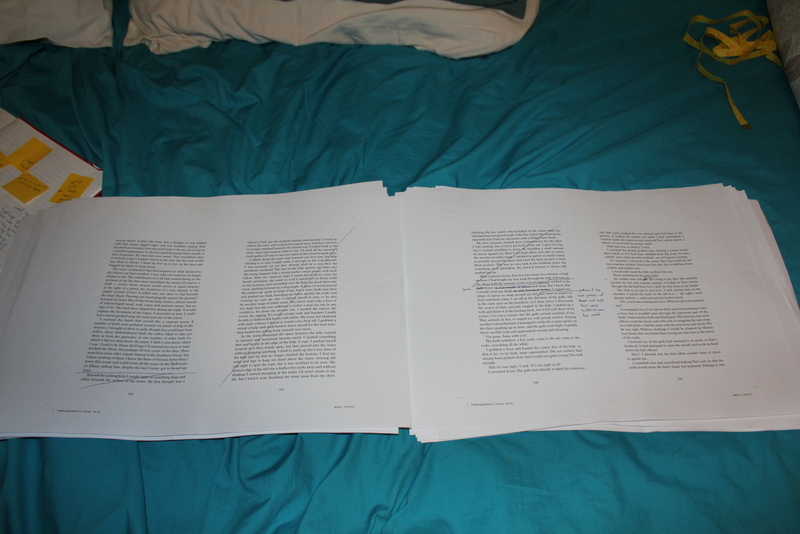
Second draft calls for a second screen
(NB: that's the Productivity Commission's draft report on Low-Emissions Economy to the left, not my novel.
And yes, I get the dissonance of printing a 500 page report on low-emissions economy.)

So I finished the first draft of my location scout novel 11 days ago. “First draft” is an accurate description of the last maybe ten pages. The first ten pages are more like “thirty-seventh draft”. Everything else sits somewhere in between.

How’d it feel to reach that point? 

Well, I used to feel stink that I had all year in Dunedin to finish it and I didn't, but that pity party petered out.

There was some elation 11 days ago, but it was specific to having had a successful day’s writing.

Back in Dunedin, I had jumped ahead and written most of the final chapter, with a square-bracketed statement at the end that indicated a one-off shift in perspective that’d last a page at most. It took me months to fill in the other blank spaces and get to that last, unwritten passage, but on the morning of Thursday 19 April, I’d reached that point, but still didn't really know how to pull it off.

It was a strange ‘writing’ day for other reasons. I had to go in to my dayjob for two meetings that were two hours apart, despite it being one of my days off, and I decided to write in town before, between and after the meetings to be efficient and avoid school holiday distractions at home. When I got set up in town, I decided to do some automatic(ish) writing to lower the stakes in a brand new environment and maybe get into this new perspective for writing later in the day. But straight away the voice just clicked. I wrote two-thirds of a page and pasted it wholesale into the end of my novel. Re-reading it after my first meeting, I repeated the first three lines at the end, wrote a better transition between the old and the new, and just like that, I was done.

Only, I wasn’t’. I’m not. But I’ve reached a milestone.

After finishing the first draft, the first thing I did was go back and change the first sentence, which alluded to a scene that no longer occurred in the novel. After that, I spent two days going through all 170 notes I’d made in Evernote, from the first one in April 2015 about what I thought might just be a short story through to notes I’d made a couple days before about things to address in the next draft. Now I have a 120-row table in Excel which I'm working my way through.

It was interesting to see that it was three years, almost to the day, since I started on this path (sometimes it feels longer - there were the two years between finishing The Mannequin Makers and the idea for this novel occurring to me; sometimes shorter - I basically started afresh in late Feb 2017). However I accounted for my time, I now had a 105,000 word manuscript to show for it. 

The quantity is there, now it's a matter of making sure there's quality, too. 

I made a mistake last week with my one pure writing day (my other day off work was a public holiday spent with family). In the spirit of gearing up for a great, systematic, enriching second draft, I decided to re-read Michael Grosso’s The Man Who Could Fly, which, despite the fact I read it two years into the project, represents a kind of ur-text for my novel. The problem with re-reading this book a year later was it was the same slog it was the first time (though without as much of my own cynicism getting in the way). Whatever momentum I’d worked up with my string of 5am starts, with every session at the keyboard moving the book forward, with the small sense of accomplishment of finishing the first draft and surprising myself with a passage that clicked this late in the process… that all drained away as I slogged through the first 100 pages of Grosso’s book.

So I put a stop to that and I’m back into my text. Making it better. Or making it different and then letting time tell me if it’s better or worse.

I’m not sure if there’ll be a clear demarcation between a second and a third or a fourth draft. Between now and the end of May I’ll go through it as often as I have to, making sure character X’s motivation is consistent, the logic for twist Y is embedded in earlier moments, the chapter titles are that right mix between intriguing and meaningful, that all the references to music on the roadtrip are absolutely necessary (my wife’s main suggestion when she read the manuscript in January)… and then I’m going to let a second person (and maybe a third) read the thing.

Maybe then, to bide my time, I'll return to Grosso...

Sunday, April 21, 2013

Where it's at (I got two book covers and microphone)

Post-its from final proofs

The Text

On Monday I couriered the final proofs of The Mannequin Makers back to my publisher. There were still a number of things that needed cleaning up - formatting stuff mostly.

This morning I went through a dozen or so queries from the second proof reader (11/12 queries resulted in tiny tweaks).

Now all that remains is to check a PDF to make sure all the changes have been made and that's the text settled. Finally.


The Playlist (for this last stretch of editing)


The Cover

I neglected to mention back in March that Random House Australia had agreed to take their own edition of my novel rather than just import NZ copies. (This made me happy as it increases the chances of getting reviews/coverage over the ditch.)

At the time, RH Australia said they'd use "the same files as RHNZ" (same text) and would probably use the same cover but can't guarantee it "as covers go through a lengthy committee process here." I read this as a piece of expectation management: 'Even if you manage to get a cover you love with RHNZ,' they seemed to be saying, 'you might not get it with us.'

In the words of Kylie Minogue: I should be so lucky. (Hey, if I'm gonna be interviewed in Australia, I'll need to get used to refering to their cultural icons instead of ours... sorry Shona Laing.)

Later in March I wrote about how I wasn't a fan of the cover Random House NZ had their hearts set on (or any of the other covers the designer had presented them), but had come to accept being overruled.

It seemed this cover was set when it appeared on the RHNZ website, though the thumbnail did say 'Not final  jacket'.


Then, ten days ago I got an email from Australia after weeks of radio silence: "We continue to work away to come up with just the right cover for The Mannequin Makers and will send you through what we have when we get something we are happy with!"

Without being told Aussie hadn't liked NZ's cover, I'd just been told Aussie hadn't liked NZ's cover.

Well, I thought, maybe I'll get one cover I like. Or maybe Australia's will be even worse!?

Last week I got a look at Australia's preferred cover and oh the relief! I liked it. (Though a few hours later I had to wonder if I'd been conditioned to like it after disliking the first cover so much...).

I also got an email from RHNZ saying the Aussie cover had been passed on to them by their Managing Director (who looks after both NZ and Australia), "as she thinks [the Aussie cover] has wider appeal than where we had got to." However, the NZ team thinks the black panel "is a bit dated" and want to work on the design "a bit further".

Right now, we're in cover limbo. As of this morning, if you go to the novel's page on RHNZ's website you'll still see the old thumbnail pictured above, but if you click on the thumbnail, or click on one of my other books, the image for The Mannequin Makers changes to the Aussie cover.


I'm just a passenger in all of this. It's pretty funny, really. In all, I'm stoked Australia and New Zealand are working together to make sure the final product is a good one, and they're both trying their best to ensure it finds as many readers as possible on both sides of the Tasman.


The launch

As the second-most anticipated sophomore book by a Kiwi fiction writer to be released in August, I'm sure the world is waiting to hear my plans for the launch event. (I could be wrong. There may be someone else releasing their second book that month, in which case bump me down to third-most anticipated).

Well, I'm meeting with the publicity manager of a certain venue tomorrow morning to discuss the possibility of them hosting the launch of The Mannequin Makers in late July/early August. Can't say much more at the moment, but if things fall into place it'll be a bit different from your average Wellington book launch. And there may be something a bit extra in the days before and after the launch.


The next project

I'm going to write a short story, but I've got such a long list of story ideas I fancy writing and I change my mind daily about which one I should write first. So I'm going to crowdsource that decision in a blog post soon...

Tuesday, March 26, 2013

Not saying no / proofs / cover / next

Not saying ‘No’

I received an email the other week asking me to take part in a book-themed funraising event that began:
Woodrow Wilson once said: I would never read a book if it were possible for me to talk half an hour with the man who wrote it.”  I am sure there are many who would agree!   
So, you mean those hundredty-million hours I spent writing my book, and the 5am starts during the editing process (which seems never-ending at the mo) have been a waste? I could have just gone around talking to people? Egad.

I was tempted to mark another thing off my to-do list ('Turn something down') but in the end, couldn’t bear the thought of not taking part. So I said yes, but mentioned that if I were them I wouldn’t use that quote again when trying to get writers to donate their time (especially if you strike a writer at the tail-end of a three year project who's very nearly ‘over it’).

*

Proof of life

Dedication
Bung dates
Last Tuesday I finished going through the first proofs of The Mannequin Makers. I had some substantive comments to make about the internal design/formatting (no contents page, please;  change how sea shanties etc are shown on the page) and caught a few errors (the dates underneath Part One were actually the dates from Part Two; one narrator says they’d never seen their aunty’s diary; later her brother knows it by sight...).

I also cut about 1.5 pages from a section in Part Three (a bit that tended to slow a chapter down and made people wonder about hypothermia).

On Wednesday I got sent some queries from the proof reader who’d been reading the same version of the manuscript (this was their first time with the book). Of the 21 queries, I agreed with 13 and stuck to my guns with the other eight.

Do I have any other comments on the proofs stage?

Cut pages
Not really. It’s nice when you first receive the proofs and see your 100k word document laid out as a book and you get to see how many pages it’ll be (around 330 trade paperback pages – ‘around’ since I cut some stuff). From that point, to the time I actually took up the proofs and started reading, was about ten days. It wasn’t reluctance to re-engage with the book (at least, not solely): my gran died, so I had to do funerally things, while still doing long hours at work, filing my column, helping out with the baby and trying to keep a level head on cover issues.

*

The cover

Yeah, so, just remember my headspace wasn’t the best.

About a month ago I was emailed a series of stock photos by Random House and given the chance to veto any images I had an allergic reaction to (I’d previously said I wouldn’t be happy with a ‘women in a flowing dress’ typical historical fiction cover). I vetoed a few.

A week or so later I got a mock-up of a cover that the Sales and Marketing team liked best. I asked to see the other options they were given. I didn’t like any of them. All bar one were stock photos with text on top: two minute photoshop jobs, tops. They looked cold and under-designed. The exception was a more stylised rendering of a dressmaker’s form (not a mannequin), but that looked too much like Chick-Lit.

I tried to put into words what was wrong with the preferred cover. If that image (a headless, limbless mannequin that inspires as much interest in me as a piece of unbuttered toast) must be used, at least do something about the typography.

I also said:
“But if I’m honest I would be a little bummed if this is the cover that stares back at me for the next three years (though it may be good motivation to write another book quickly).”
This was the day after my gran died, and I apologised for being grumpy in my next email.

I moved from dislike to acceptance to not giving a damn over the next couple of days.

I know the final call on the cover is not mine to make, and maybe the Sales and Marketing Team knows best (I don’t have enough evidence here to be snarky). And maybe, once there’s a back cover and it’s printed and wrapped around 330-odd pages of literary goodness (or literary passableness) I’ll be fine with it.

*

What’s next?

I get the final proofs after Easter and have another fortnight to turn them around. Final sign-off at the end of April.

I have a grand idea for a launch event but have to talk to some people before I say anything. If this idea falls through I guess it’ll be cheese and pineapple hedgehogs in the Ministry of Education cafeteria. Walk socks and sandals optional.

Monday, March 4, 2013

Notes on being thoroughly edited


Subtle misdirection: this scene looks nothing like anything in my novel 
I've recently come out the other side of a rather intensive editing process for my novel, The Mannequin Makers. I didn't go through anything like this with the manuscript for my short story collection. Sure, the freelance editor in that case changed a lot of commas and reformatted things into the house style, but I can only think of two or three meaty queries (a conversation they felt sounded artificial, a child they felt sounded too old, ‘does an oxalis leaf really feel like a dried apricot?’). There were probably a few more, but A Man Melting is pretty much as I wrote it.

Flash forward three and a half years and I’m in the delivery suite at Wellington Hospital. Labour is progressing slowly (it’ll be another 14 hours before my daughter pops out) and I have time to check my emails. Waiting for me is a message from my new editor saying she’s just read my book, likes it, is excited to work on it, and here are some high level thoughts. Over the next few hours I tinker with a response (one of the suggestions is something I’m dead set against: changing how Part Three is narrated will cause other parts to unravel!) but I don’t end up sending a reply until Lia is a week old.

My editor and I exchanged a couple more emails about high level things (the melodramatic ending, the voice of one of the narrators) and other, more focussed, questions, like ‘Could a Maori be mayor of a town in New Zealand in 1919?’ We came to agreements over these issues and my editor delved into marking up the manuscript line-by-line.

Toward the end of January the ball was back in my court. As I started working through the comments and suggested changes — there were a lot! — I began to wonder if there would be a page in the manuscript that didn’t need changing…

Turns out: no. Not unless you count half-pages at the end of chapters. There were a few pages with only one edit (pages 105, 123 and 144 for those of you playing along at home), and I scrutinised these, hoping I could reject the change and reaffirm the honour of the page, but alas, they were necessary.

Necessary. As in, this book cannot see the light of day until what I wrote (and revised numerous times myself) is changed. Every necessary edit is an admission I am not omniscient. That I could not bring this book to life single-handed.

As I waded deeper into the marked-up manuscript I began to feel as if I’d handed over a flabby mess. A tedious and inexact (what a stellar combo!), overwritten and over-explained, grammatically clumsy and anachronistic eyesore.

Some perspective is needed, of course. It’s the editor’s job to find the errors of fact or taste. It’s not their job to pad my ego. Running through the suggestions in a 105,000 word document, the writer is only seeing the editor’s question marks, never the ticks.

Doing a creative writing workshop teaches you a little about the process of getting feedback, knowing what to take on board and what to stick up for. But editors aren’t paid to use the sandwich technique (open with a compliment, then get to the constructive criticism, close with a compliment). Writers after ego-stroking should not look to the editing process for validation.

But this dude, he's totally in my novel
(though not on a bicycle, sadly)
Getting edited is a bit like receiving the worst review ever. That one you dream about the night before your book comes out, where someone you respect has mercilessly picked at the minutiae as a way of proving THIS WRITER IS NO GOOD AND NOT WORTH YOUR TIME. There’s no time to talk about the story because there’s so much else wrong with the book. Look, they don’t even know when to use ‘lay’, ‘laid’ or ‘lain’!

But, you remind yourself, this is not a review. There’s still time to make these changes and save face. You convince yourself this, but as with a bad dream, you still carry it round with you the rest of the day — that sense of shame.

As I got further into the manuscript and felt the scales tipping back in my favour (‘I’ve improved the first half of the book... the first three-quarters... the whole book will be better than when I started…’) I felt myself coming to terms with the prospect of bad reviews. ‘Okay,’ I thought, ‘if there’s a pedant out there who picks up a perceived anachronism, so be it. That’s just them trying to prove they read the book closely.’ 

Sometimes they’ll be wrong, of course (more on this later). But the real hatchet jobs, at least in NZ, are likely to stray wildly from the text and focus on the big issues, like the fact I’m no Franz Kafka and produce McLiterature. This sort of review one can deal with.

So what were some of these necessary changes? And what did I push back on?

Past tension

This was the first time I’ve tried to write anything set in the past, and though I was pleased with what I was able to create and hand over to my publisher late last year, seeing the edits, it’s clear I still have some blind spots. You might say I have a long way to go before I could be considered rigorous in my historical accuracy.

A random example: after my roadtrip around South Canterbury/North Otago in 2011, I was struck by the town halls in places like Palmerston. It took me a long time to figure out what that pebbledash effect was called (rough cast) so that I could mention it in passing in the novel, only for it to be 30 years too soon when I used it in the novel (rough cast was a 1920s thing, but I’d mentioned it in the 1890s).
I'd have saved us all some time if I'd just
zoomed in on my photo (built 1911)

With things like this, I tssked myself, accepted the change and counted my blessings my editor had picked up the anachronism.

Concrete things like architecture and technology are pretty easy to resolve, but there were quite a few times where my editor questioned how characters talked. Sometimes the criticism was bang on (‘Run them past me,’ ‘big reveal’, ‘Don’t get me started’) and other times I found myself pasting links to Papers Past or Youtube to prove people back then talked or acted like they were talking or acting in my novel.

But that’s not the end of the story. Even if people did talk like that ‘back then’, should they talk like that on the page? There is always a tension between what actually happened and what people think the world was like in a past time. The things people question — were gossip columns so cheeky and forthright? Did they use ‘sunshine’ as a (sarcastic) term of endearment? — are liable to throw readers out of the story EVEN IF it’s historically accurate. A novel is not like a Wikipedia page where you can provide citations and hyperlinks to prove you haven’t made this shit up — well, you have, it’s fiction! — or at least that you haven’t made a historical flub.

On the one hand, I don’t want to throw people out of the story with things that seem anachronistic. But on the other I don’t want to recreate a period based purely on what contemporary readers expect it was like.

A line of dialogue is small biscuits, really. I’d be silly not to change the line to keep reader’s engaged in the story. It’s a novel, after all, not a history book about South Island vernacular 1890-1920.

The issue becomes more fraught when we talk about what the culture was actually like back then. One of the big things I want to get across in the first part of the novel is that urban NZ in 1902 wasn’t the dour, sour, isolated no-fun place many think (the image is more appropriate post-WWI). I didn’t know this myself at the start of the project and didn’t know it would be a subtle but vital part of the first fifty pages of the book – but that happens all the time when writing.

In trying to present this more-vibrant-than-you-might-think world, I’m inviting people to be thrown from the story — is that really what I want to do? My editor pointed out a few things that threw her. She felt particularly thrown by a gossip column that appears in the novel. It was, of course, a fake column from a made-up paper (the Marumaru Mail), but this implag (‘imported plagiarism’) conformed to the tone and style of some of the columns I’d come across while doing my research. After all, I didn’t just come up with the idea of writing a one-off entry of a made-up column in a bawdy style. But when the historical fidelity of such a fake column was questioned, I went back to the real ones I’d read and conceded that the most shocking were in metropolitan weeklies, rather than small town dailies like the Marumaru Mail is supposed to be. So I toned things down slightly, but fought to keep the column in the novel as it’s one way to open a window to the more lively aspect of pre-WWI New Zealand (while also giving readers some relevant info about characters in the novel if they’re prepared to dig/decipher).

A lot of people don’t like implags… I only had about four or five in my manuscript and they all got the “Cut?” from my editor. But I like implags. I think they do a lot of work for a small amount of text, and if pulled off well, add a layer of richness and sense of time to a story. I did let two implags hit the cutting room floor when they weren’t needed as a result of some other changes to the final section, but even that was hard.

Here’s one that got cut:

SUICIDE IN MARUMARU
Florence Pettaway, aged 33, unmarried and living with her brother-in-law near Marumaru, was found hanged in a shed yesterday. The deceased had been melancholy for some days.

This took me a couple of hours to craft these two lines. I needed to research how notices like this were written at the time. Without this piece of reportage, readers will no longer know this character’s last name, her age (though you can work it out), or the way her life would have been essentially dismissed by the newspaper (and, by extension, society). All good, worthy things. But it just didn’t seem right for my not-so-literate narrator to be cutting and pasting from the newspaper. Voice drives form, which leads me to...

Hearing voices

Writers often talk about struggling with a piece until they ‘find the voice’. This is particularly true of first person narrators, of which there are three in my novel. Each time I slogged and slogged and got nowhere until something clicked and the new narrator’s voice became an almost audible presence that carried me forward.

During the editing process, I realised a lot of the things my editor was cleaning up were things I had dictated from this voice. My knee-jerk reaction to a lot of these suggested changes was, ‘But that’s not how Avis/Gabriel/Eugen talks.’ But these voices that arrive are never perfect. Yes, I was able to tap into some part of my unconscious that could do a pretty good facsimile of a bookish sixteen-year-old girl in 1919, but it was only pretty good. Turns out, there was still a lot of 2011/2012 in her voice too, and only someone with fresh eyes (and no mystical voice in her head) can flag the hiccups and the howlers...

This is not to say that I accepted the changes wholesale. I picked my battles and fought for the odd overreached phrase or over-explanation when it’s driven by the character of the narrator (rather than the novelist pushing his own agenda — of which I’m guilty sometimes —  or the novelist channelling an imperfect voice he is too stubborn to admit could sound even better).

Tics and idiocy

All writers have tics. Some are thematic. Like how my stories tend to revolve around fathers: artistic fathers, absent fathers, stern fathers, concerned fathers, de facto fathers. I also have some tics at the sentence level, some of which are part of my received Manawatu plains vernacular. Most of the tics that got pulled up in the manuscript for The Mannequin Makers, however, were related to the voices of the narrators inside my head. My editor pointed out how fond I was of ‘atop’, ‘hoisted’, ‘eased’ and the colour orange (for dresses) - all things that, when examined post-mortem, sound slightly antique and more active than ‘on,’ ‘raised’, ‘lowered’, and a more common colour. But, overused, these words lose their value too.

A lot of things were ‘compared to’ others, rather than ‘compared with’. This might be part of my imperfect vernacular and I was happy to revert to the more formal sounding ‘with’.

And then there were the moments of sheer idiocy, like when I wrote ‘descended down the ladder’ and my editor swiftly removed the ‘down’. Phew!

Praise be to editors.

Proof positive

The process of going through my edited manuscript involved a lot more than ironing out the tics and anachronisms. I also rewrote large chunks of the final section to improve the ending and make it all hang together better.

When I sent the manuscript back with my blue edits mixed with my editor’s red ones, our comment balloons cramming the right margin, I felt two things:

One: this manuscript is a frigging mess.

Two: this manuscript is 200% better than the one I sent off a couple of months ago.

In order to reconcile these two impressions, before I hit send I asked myself: is there anything here you wish you could change if you had another week? There were passages I’d have liked to read again with fresh eyes. There were a few changes I wanted to sleep on for another night. But there was nothing more to do just then.

I hit send.

The first proofs are being couriered to me now and I expect to find them waiting for me when I get home from work tonight. I’ve now had the chance to sleep on the changes. I have relatively fresh eyes and the new booky layout of the text should help.

So it’s the start of another few weeks of pouring over my baby before I hand it on to someone else again. All those possible books I could have written when I started with the idea of a mannequin maker and a shipwreck have narrowed to one. All those ‘first’ novels I’ve worked on or daydreamt are about to be trumped by a real first novel. I’m anxious and pleased. I’m ready to bounce from pride to shame at the sight of an errant coma. I’m tired — so tired —  but I’m nearly done.

Sunday, February 3, 2013

January reading summary

I'm up to my eyeballs in edits for The Mannequin Makers at the mo. Working to a deadline while working full time and sleeping if and when my daughter deems it appropriate.

I hope to write a detailed post about the editing process after I'm over this next hump, but until then, let's talk about books by other people!!

January seems to have been a month out of the ordinary for me, with at least three books with fantasy elements (not normally my bag). But it’s always good to wade into different waters.

Flight
Flight by Sherman Alexie (novel, audiobook, US)

I thought for the first hour that it was really good, then it went suddenly and terribly wrong (as in: extended dream sequence lasting ¾ of the book).

The Night Circus
The Night Circus by Erin Morgenstern (novel, audiobook, US)

I didn’t want to like this book. I didn’t even want to read it, but somehow it wound up on my iPod. The Night Circus has elements of Neil Gaiman, Christopher Priest (the dude who wrote The Prestige, my favourite novel about magic) and Great Expectations. It's engaging to begin with, but poorly structured and drags for long stretches. And personally I favour fiction that tackles illusions rather than actual magic.

Zoo City
Zoo City by Lauren Beukes (novel, South Africa)

This felt like Elmore Lenard’s Be Cool, transplated into a twisted Johannesburg (and a world where, if you do something really bad, you get saddled with an animal like a sloth or a meerkat). Sadly, Beukes’ writing does not have Lenard’s restraint and I got seriously lost in the climax (as in: where is she now? Where are these other people? How can she hear them and they not see her?).

Big Country: Ride, You Tonto Raiders and War Party
Big Country by Louis L’Amour (short stories, audiobook, US)

This audiobook contained two longer stories from one of the best selling authors of Western. A bit of sunny, parched-earth fun for Summer – but I was actually quite impressed with L’Amour’s writing: it’s more restrained and smooth than I expected from someone associated with pulp.

The Ongoing Moment
The Ongoing Moment by Geoff Dyer (non-fiction, UK)

Interesting discussion of photographic tropes (hands, other photographers). Wildly divergent, often facinating, but by design it’s bitsy and disjointed.

A Heart So White
A Heart So White by Javier Marias (novel, Spain)

An interesting set-up buried – quite deliberately – beneath over-analysis and naval-gazing. Is it possible to think a book really good and freely admit to having skimmed large amounts? Well?

Tuesday, December 11, 2012

'Welcome to What Next, Population: You'

I’ve been MIA for the last couple of weeks. No, the baby hasn’t come yet (due date is tomorrow: 12/12/12, which was always too perfect to ever happen; I’m just hoping it doesn’t arrive too close to Christmas).

But I have delivered my other baby (for the second time).

Last Tuesday I sent The Mannequin Makers back to my publisher after spending two months making some tweaks, thanks to the useful feedback I received.

(In truth, I spent the first month watching Australian TV shows from the 1970s on YouTube -- Number 96, The Paul Hogan Show, The Great Temptation -- which was a research dead end. Even at this late stage, it isn’t always clear what belongs in a book and what doesn’t.)

Now the manuscript is with an editor who I’m excited to work with. Maybe it’s the masochist in me, but I enjoy this process of giving my baby over to someone else and letting them cover it in red ink, this game of manuscript tennis that eats up month after month. So long as you don’t forget who you are and what you set out to write, you’ll make the right changes, lessen the areas readers can get mired, lost, annoyed, or misled and amp up those moments you always thought should sing but maybe never quite nailed.

Every new version is an improvement on the last. Every new version is an improvement on the last. Every new version is an improvement on the last.

Maybe, by the end of this, we will have a book that some readers read through to the final page. Maybe some will like it, steal it from the library, name their children after its characters… Maybe it will annoy great swathes of people, get thrown across drawing rooms (I don’t think my target market has ‘drawing rooms’…), prompt lengthy ad hominen blog posts and snarky tweets. Maybe it will sink like a stone next year and I will be too busy fathering a real baby to notice. Maybe I will be juggling a real baby and another book-baby.

At this stage, I cannot say – not because I am being coy, but because I do not know.

I have entered the territory of ‘What Next?’ I have no map. I don’t speak the language here. Maybe I do, but I speak it poorly and when I ask the locals for directions they turn their noses up at me and walk away.

Deciding on your next project is a lot like your first week in Paris. You’re busy, confused, bumbling. Embarrassment is there to meet you at every turn. You’re surrounded by houses with plaques declaring the famous writers who’ve lived there. They’ve made their name, staked their claim. There’s nothing for you here, move along.

But eventually you will find that small café down an alley the other tourists don’t seem to notice. A place where the waiters humour your mangled recitation of the menu. A place to sit and let the world come to you. To get to know the regulars and the pigeons, the bitter kick of the coffee, the quiet hour after lunch when the wind toys with the morning’s newspapers.

Soon it will feel like home, this place. It will be knowable. Your knowledge of it will become comprehensive, then godlike, omniscient. You will use this knowledge to toy with the regulars, the pigeons, the headlines on the morning papers – petty games, but it keeps you occupied.

And then, one day, you are done with this place and it’s time to move on. It’s off to the airport and another foreign city, another busy, confused, bumbling week, or month or year.

As you lie on another lumpy hostel mattress, you tell yourself: next time I will read the travel guides in advance. Next time I’ll take language lessons beforehand. Next time I will draw up an itinerary and stick to it.

Or maybe you’ll just write short stories…