Showing posts with label warren zevon. Show all posts

Monday, August 5, 2019

Nailing Down the Saint: The Playlist

So I wrote another novel and it comes out tomorrow in Aotearoa New Zealand. It’s called Nailing Down the Saint and it’s about Hollywood, fatherhood and levitation. Here’s 70 minutes of music of special relevance to the project, and a bunch of words about that music (and other things).


1.     Patient Zero – Aimee Mann

If Nailing Down the Saint was Season Two of a TV show[1], this song that might play over the “Previously, on” recap: A young man arrives in Hollywood. The world lays at his feet. But things don’t go as planned.

There’s this point, two and half minutes into the song, just after Mann sings, “You paid your respects like a ransom / To a moment that was doomed from the start”, and there’s this low, ominous piano note. The song continues, but that note once struck can’t be unstruck. Things have turned to shit, even if you aren’t ready to admit it yet.
Welcome to Duncan Blake’s life in LA.


2.     Bedtime – Gord Downie

This song, the 3rd track on Introduce Yerself, kicked me in the guts so friggin’ hard when I first heard it, still reeling from Downie’s death[2], knowing he wrote it as his days with his family were numbered, and have young kids myself. The song recounts the struggle to get a young child to sleep, laying them down, pulling your hands away,  “as if from a bomb”, and getting out of the room, only to be called back in and for it to “start all over again”.

In the midst of this routine, it can seem a trial. Interminable. But what goes unsaid here is this eminently and imminently mortal father would give anything to go through it again. What might sound like a lullaby to someone not paying attention is actually an ode to fatherhood and a goodbye.

In NDTS, the protagonist, Duncan, has a nearly four-year-old son, Zeb, and thoughts of time passing and not being there for Zeb fuck him up. If he heard ‘Bedtime’, he’d be reduced to a puddle of gloop like *that*.


3.     Tinseltown in the Rain – The Blue Nile

So Duncan has moved to LA to continue his meteoric rise in the world of filmmaking, but was fucked over, then fucked up by fatherhood, and finds himself working in a chain restaurant in West Hollywood.

The penultimate chapter of the first section lifts its title directly from The Blue Nile’s song. With its synth-heavy, questioning mood – “Why did we ever come so far? / I knew I'd seen it all before / Do I love you ? Yes I love you / Will we always be happy go lucky?” – it feels like the mopey section of a John Hughes movie, which is absolutely something Duncan Blake might think in the moment before he gets his second chance handed to him by Frank Motta.


4.     Horizon – Aldous Harding

These next three songs are dedicated to Felicity “Mack” MacKinnon, Duncan’s best friend from high school, who, after a period of estrangement, joins him on his Italian quest to scout locations for Frank Motta’s biopic of Saint Joseph of Copertino (more on him in a bit).

When I first heard this song in 2017, I thought: that’s Mack. Here’s something I’d already written about her (and that’s in the final novel):

‘Come on, babe, play nice.’ She’d called him ‘babe’ since forever. Had shown up at his high school calling everyone that, like some Hollywood producer posing as a fourteen-year-old schoolgirl, only she seemed to be doing it ironically. As if she’d ever turn Hollywood! She was real, belonged to the world of cellulite, not celluloid, could bend old language around new corners. It was as if every ‘babe’ had an implied, parenthetical retort, like the title of an unlikely pop hit.

(You’re no picture yourself) Babe.

(Nothing you can do can get to me) Babe.

Harding’s spare-yet-epic, totally cinematic masterpiece is likewise riddled with complex, terminal “babes”.


5.     It’s Alright (Baby’s Coming Back) – Eurythmics

The only thing is: Aldous Harding is more Duncan’s kind of music than Mack’s.

On the road trip, she’s the master of the in-car playlist, leaning much more toward the nostalgic (or what counts as nostalgia for a child of the 80’s and 90’s).


There was A LOT more banter about music while Duncan and Mack travelled around Italy in the first draft of NDTS, but this had to (HAD TO!!) be pared back. Examples of riffs that ended on the cutting room floor: how OK Computer-era Radiohead sounds like a piss-take of 90’s po-faced seriousness; on nostalgia and wistfulness; how Lennox and Stewart are a better songwriting duo than Lennon and McCartney… That’s not a hill I’m willing to die on, but I will sit at the summit until some vinyl-smelling boor comes to chase me off.


6.     I Will Wait – Hootie & the Blowfish

One thing I couldn’t cut was Mack and Duncan arguing about this song.

I was very much in Duncan’s camp (i.e. it is unconscionable to enjoy, yet alone publicly endorse Hootie & the Blowfish) for most of my life[3]. But I’m now Team Mack on this particular track. Add it twice to your next road trip playlist: once to get over the hump of your fellow travellers’ prejudice and a second time for the singalong.


7.     Can’t Keep Checking My Phone – Unknown Mortal Orchestra

I saw UMO live in Wellington in December 2015, when progress on the novel was stymied. I’d written about 10,000 words the year before, then got very sick for a fortnight and couldn’t get clear of family and work commitments to get the ball rolling again. But I could still faff around on my phone and go to concerts and have transcendent experiences listening to Ruban Neilson do Prince via T-Rex through one of those tin-can-and-string telephone getups.

When I got back into NDTS the next year, UMO’s Multi Love was still on high rotate and Duncan’s cellphone became one of the major characters – a know-it-all who sucks the mystery out of tipsy wonderings but can’t help get you out of the tangle it has led you into in the medieval centre of Assisi.

Then there’s Duncan’s female friend from work in LA who’s What’s App-ing him, desperate to know how his road trip is going…


8.     Sitting in my Hotel – The Kinks

‘Celluloid Heroes’ might be the more obvious Kinks song here, but that song sucks.

This one, however, is up there with ‘Sweet Lady Genevieve’ as the underappreciated Kinks masterpiece.

It has that classic, fame-is-a-downer vibe that can translate even when you’re not famous (which is, let’s face it, most of us), just simply alone in a hotel room, or, right next to your best friend in a room in Pietrarubbaia and you realise that you’ve been criminally incurious about her life and motivations.


9.     A Private Understanding – Protomartyr

The best track from my favourite album of 2017 (Relatives in Descent), the most important year in the creation of NDTS.[4]

You can read a lot of things into the lyrics, so of course I see connections with my novel, but in 2018 I learnt another thing I love about Protomartyr while preparing to see them live[5]: that the frontman, Joe Casey, didn’t join a band until he was 35 (my age at the time), couldn’t play an instrument (like me, despite those three terms of classical guitar tuition at Intermediate) and struggled with stage-fright (hence the dark glasses and static stage presence). There’s even a Tumblr dedicated to journalist’s overwrought descriptions of him.

“The one who looks like a Belgian lorry driver is lead singer Joe Casey”

And yet here he is, singing songs about the Flint water crisis, the plague of toxic masculinity and the mysterious hum that can be heard in Windsor, Ontario.

A hero for our times!


10.  My Body – David Bazan

This was my favourite song of 2018. If 2017 was all about the first draft, 2018 was about actually writing an ending (!) and rolling through the manuscript again and again until it was fit for someone else to read (the editing process took me through to mid-2019).

Bazan solo and in all his other projects is amazing. Everything is shot through with the anxiety that comes as another mediocre (or not) white dude with a microphone.

‘My Body’ speaks directly to the concerns of NDTS.

Honestly, pick any line.

Or just start from the beginning: “This feels like a disproportionate amount of longing / More confirmation I was never meant to live alone”

(I mean, who write lyrics like that?)

As Duncan gets further and further into his location scouting gig, his native scepticism about the feats of Saint Joseph of Copertino, a seventeenth century Franciscan friar who is purported to have levitated hundreds of times and performed countless other miracles during and after his time on earth, is eaten away. To the point he might admit, as Bazan does in his chorus: “My body doesn’t believe what my mind believes”. Might.

Image result for Mind Games: The Guide to Inner Space by Robert Masters and Jean Houston
11.  Mind Games – John Lennon

I’d never really listened to, or thought about, the lyrics here until I was writing this book. I’d just assumed it was about the mind games two people in a relationship play, but it’s a much more positive type of mind game Lennon is talking about – inspired by the book Mind Games: The Guide to Inner Space by Robert Masters and Jean Houston – and totally in keeping with Lennon in 1973.

For a while I wanted to call the novel Absolute Elsewhere, after a lyric in this song[6]. Instead it’s just a chapter title (along with another lyric, ‘Out of the Now’) and I let someone in sweatpants mangle it on guitar to a pizzeria full of cult members.


12.  Strange Torpedo – Lucy Dacus

Another chapter title.

Dacus has explained that she was inspired by a line in Fear and Loathing in Las Vegas, but I still can’t avoid the phallic associations of a ‘strange torpedo on the loose’ – which fits in with the theme of Hollywood enabling the unchecked masculine gaze…

Having said that. the strange torpedo in NDTS is a dead blackbird a young girl is trying to bring back to life in a convent carpark.


13.  Stay Lost (acoustic) / Tinseltown Swimming in Blood – Destroyer

This double shot from the deluxe edition of Destroyer’s Ken (2017) rounds out the Italian portion of the novel. Not gonna divulge any spoilers, but from the song titles themselves you can begin to surmise how things round out for Duncan with Mack and Motta.


14.  The French Inhaler – Warren Zevon

Early in the novel, there’s a discussion of Frank Motta’s oeuvre, including a film called French Inhaler, about “the ultimate kiss-off song [i.e. Zevon’s]. A cross between a talking heads documentary and crime scene re-enactment.”[7]

Thematically, this track and the way it crosses the line for both misogyny and self-loathing fits much better at the tail end of this playlist and the moment for Duncan “when the lights came up at two”.


15.  Mariners Apartment Complex – Lana Del Rey
16.  Green Light – Lorde

Image result for lorde lana del rey

It’s important to finish this playlist with some younger, female voices for reasons that will be apparent to anyone who gets to the end of NDTS.

I’ve long been a sucker for the overtness of Del Rey’s façade and the performativeness of her songs, but ‘Mariners Apartment Complex’ appears to mark a more personal turn in her song writing. When she sings, ‘I’m your man’, in the chorus, it’s about self-empowerment and reclaiming gendered language and everything you want to surround your kids – female, male or otherwise - with.

Then there’s Lorde.

Melodrama came out in 2017 and was on high rotate as I wrote NDTS. But I was also in the US in 2013 when ‘Royals’ started to blow up (and Ellie Catton won the Booker Prize) and it was this amazing moment for young Kiwi women and I was struggling to start something new after my novel, The Mannequin Makers, had come out and would struggle for another four years…

So when Lorde kicked off her sophomore album with ‘Green Light’, a perfectly complex dancefloor jam about almost having the licence to just let go, it struck a chord with this thirty-something, who, like Duncan Blake, had “skin the colour of old lace, a penis and a second chance.”


[1] It’s not – it’s a standalone novel – but if it was…

[2] If you get to the end of NDTS, or if you’re like me and you read the acknowledgements page first, you’ll see that I dedicate the book to the memory of Gord Downie, the Canadian musician, writer and humanitarian best known as the frontman of The Tragically Hip. Downie recorded his final solo album, Introduce Yerself, while in the late stage of his battle with brain cancer. It was released 10 days after his death in October 2017, when I was in the midst of writing the first draft of NDTS. I’d been a rabid fan of The Hip and Downie’s solo work for more than a decade, and had shared a brief email exchange with him in the early 2010s which included me sending him my first book, but it felt to personal, too chummy, to have the dedication open the book. So that’s why it’s tucked away in back.

[3] I once flatted with a person who was inconsiderate, untidy and morally bogus (she expected us to lie to her husband when he called), but at the time I thought our most emblematic exchange was when, the one time she actually decided to clean the kitchen, she was blaring an FM station and said to me, “I just love Hootie and the Goldfish, don’t you?”

[4] The formula is pretty simple if you wanna pander to my tastes: dark, brooding music with evocative yet unpindownable lyrics = fantastic music to listen to while writing = dozens of streams.

[5] It was a great show BTW.

[6] Bullet dodged.

[7] One of the cool things about creating multiple filmographies was coming up with movies I wish someone would make. I mean, this craze for basic pop biopics baffles me when there’s so many more interesting stories to be told. Listen to ‘The French Inhaler’ and then Loudon Wainwright III’s ‘Hollywood Hopeful’ and tell me these songs haven’t just conjured up 90 minutes of screen time you’d actually leave the house for.

Tuesday, July 30, 2013

The Mannequin Makers Playlist

It's that time again. Time for a Largehearted Boy-esque playlist for my new book, The Mannequin Makers.

You can check out my playlist for my short story collection, A Man Melting, here. Back in 2010 I picked a song for each of the 18 stories, and the range of artists (Van Halen, Paul Simon, Gene Kelly, The Go-Betweens, The National, Los Fabulosos Cadillacs, Milli Vanilli) reflects the diversity of the collection.

A novel, of course, is supposed to be more unified. That is not to say it doesn't range widely (from Scotland to the subantarctic; from the 1860s to 1970s), but it has still resulted in a less eclectic playlist than last time, I think.

I've split my playlist into four parts to mirror the structure of the novel. The three or four songs for each part are a mix of songs I listened to often while writing, songs I came across at pivotal moments, or songs that just seem to fit that particular part of the story.

For those of you coming to my book launch tomorrow (6pm at Kirkcaldie and Stains; the doorman will let you in), these'll be the songs playing in the background as you skull your pinot and try and catch the eye of the waitress with the platter of corn fritters...


Part One: Welcome to Marumaru

'Death and the Maiden' by The Verlaines

Shall we have our photo taken?
We'll look like Death and the Maiden

Great song, great band. I got into this track again via a cover by Stephen Malkmus, but the original is better.

Thematic link: the idea of posing for a photo based on a work of art. In the case of The Mannequin Makers, that art is, funnily enough, mannequins:
"Perhaps most tellingly, when a visiting photographer set up his equipment at Hercus & Barling the townsfolk chose to be immortalised performing the poses of The Carpenter’s models." (p30)
'The Killing Moon' by Pavement (Echo & the Bunnymen cover)

He's a yo-yo man, always up and down
So take him to the end of his temper

Keeping the Stephen Malkmus thing going, I reckon this cover by Pavement of Echo & the Bunnymen's song is better. Or at least, I listen to it a lot more than the original.

Temporary thematic link: I wilfully misheard the line "take him to the end of his temper" as "take him to the end of this tableau" for the longest time. (The living mannequins refer to their displays in the department store window as 'tableaux'). But the creepy vibe and lyrics do sorta suit the father-villain, Colton Kemp, who's the focus of Part One.

'The Outer Skin' by Sean Donnelly (Chris Knox cover)

And it seems like nothing can penetrate through the outer skin
Crouched and cold on a slate grey day in the Southern world

Another cover. There's probably a thematic link between Colton Kemp's attempt to recreate life in the form of wooden mannequins and artists trying to breath new life into other artist's songs... but let's not get too carried away. Again, I mostly chose this track because it sounds like I think Part One reads, and I listened to Donnelly's version a lot more than Knox's (partly because Knox's version isn't available on Spotify, but Donnelly's is).

*

Part Two: The Mannequin Speaks

'My Rights Versus Yours' / 'Adventures in Solitude' by the New Pornographers

Under your wheels, the hope of spring, mirage of loss, a few more things
You left your sorrow dangling, it hangs in air like a school cheer

-
Less than forget but more than begun
The adventures in solitude never done

This is the first of several cheats. A double shot from the New Pornographers because:
  • I couldn't choose between these two songs
  • they both seem important to the novel and apropo given what takes place within its pages.
I got into New Pornographers during the three years I worked on The Mannequin Makers and was lucky enough to see them live and intimate at the San Fran Bathhouse here in Wellington. Great concert. Great band.

'Pascal's Submarine' by Gordon Downie

Stumbled in to sleep's ravine
Into a dream of Pascal's Submarine
Where if you can remain quiet and still
You might escape life's fill of misery


This song actually stared me towards Blaise Pascal, who supplied the epigraphs for my novel (one at the start, then one for each of the four parts). The epigraph to Part Two "... all man's misery stems from a single cause, his inability to remain quietly in one room," is reflected in Downie's song, which is really about the sinking of the Russian submarine, Kursk, in 2000.

'Eye in the Sky' by the Alan Parsons Project

The sun in your eyes
Made some of the lies worth believing


I heard this song while driving out to Cattle Creek during my research roadtrip. It was actually a double shot of Alan Parsons, with the instrumental 'Sirius' up first, followed seamlessly by 'Eye in the Sky'. I recognised 'Sirius' from Jordan-era Chicago Bulls starting five introductions, but was less familiar with the second song. Still, one listen was enough for me to be earworming it for the rest of the trip. It just seems to fit that part of the world, where Avis winds up at the end of Part Two. The vague religiosity, the keyboards, the creepiness... a perfect fit for the introduction of The Carpenter.

*

Part Three: The Carpenter's Tale

 'Tales of Brave Ulysses' by Cream

And you touch the distant beaches with tales of brave Ulysses,
How his naked ears were tortured by the sirens sweetly singing,
For the sparkling waves are calling you to kiss their white laced lips.


This is one of those songs I rediscovered late in the process of writing The Mannequin Makers. I was at a friend's, in charge of choosing which LPs to play. At the top of the pile was Disraeli Gears, and when 'Tales of Brave Ulysses' came on, I thought, 'Ah! This song.' I entered a note in my phone to listen to this song again when I was at home and proceded to thrash it for the next couple of months.

Part Three opens with The Carpenter lashed to the mizzen mast of a clipper ship, with a storm approaching. I was thinking about The Odyssey when I concocted this scenario, and it turns out the narrator (The Carpenter) who read a lot of epics and Penny Dreadfuls when he was younger is thinking about these kinds of stories when he starts telling his tale.

'South Australia' by The Pogues

And as we wallop round Cape Horn, heave away, haul away
You'll wish to God you've never been born, we're bound for South Australia

There are a couple of sea shanties in Part Three, one is completely invented, another is a modified version of the 'South Australia' shanty sung in the mid-late Nineteenth Century. The Pogues' song is based on the same shanty. There are dozens of versions of 'South Australia' on Spotify by a range of artists. I like the Pogues version best, hence it makes my playlist.

'Nautical Disaster' by The Tragically Hip

The selection was quick, the crew was picked in order
and those left in the water got kicked off our pantlegs
and we headed for home.


Anyone who follows this blog knows there had to be a Tragically Hip song in here. And no, a song by their frontman (see 'Pascal's Submarine') was not enough.

This song about a fictional shipwreck gets the nod for this section of the novel, which has its own fictional shipwreck.

'How to see through fog' by The Drones

And they only ever think you're good
When you're walking like you're made of wood

This song only came out in January 2013, but it was on high rotate as I worked through the editing process. It seemed to really fit the passages where The Carpenter is marooned in the subantarctic, and the whole figurehead/mannequin carving thing. This fan-made video featuring mannequins, zombies and blood, makes some different, but equally valid, connections.

*

Part Four: The Mannequin Speaks

'Lovers in a Dangerous Time' by Bruce Cockburn

Spirits open to the thrust of grace
Never a breath you can afford to waste


The award for biggest earworm during the writing on The Mannequin Makers goes to this Canadian classic. There's something addictive about the low drone of Cockburn's "Luvverrrs... in a dangerous time" at the start of the chorus.

You can probably pour over the lyrics for connections with what happens in Part Four, but I'm happy to let Bruce do the talking.

'Numb as a Statue' / 'Wanted Dead or Alive' by Warren Zevon

I'm numb as a statue
I may have to beg, borrow or steal
Some feelings from you
So I can have some feelings too

-
I am wanted dead or alive
I'm a new kind of man
I've got to survive


Another double shot, another artist who I listen to religiously. 'Numb as a statue' is pretty prefect for the narrator of Part Four (Eugen Kemp), while 'Wanted Dead or Alive', off Zevon's oft-maligned (but I kinda dig) first album captures the western feel of the journey to the hinterland.

'Murderer' by Low

You may need a murderer
Someone to do your dirty work

I listened to a lot of Low while writing The Mannequin Makers. They're this book's version of The National (who I thrashed in 2008 when working on A Man Melting): dark, repetitive songs that make for great writing music. They also fit pretty well with the M.O. of my novel (described by Random House's international rights person as "quietly horrifying", which I'm now using myself without hesitation) - 'Murderer' is a particularly good example of this and a fitting way to end my playlist.

Right, guess I have to write another book now. See you all again in three-to-five years.

Wednesday, May 30, 2012

Spotify: I'm sold (on the free version)

Days of the New

Back in November 2010 I wrote a column about the theory that most people stop buying music by new artists by the age of 26 (at the time I was 27; cue chin-on-hand, watery-eyed reminiscence about fleeting youth). It certainly rang true for me:
When I was 25 I was still seeking out new-to-me artists and buying their music. That year I got into bands like Beirut, The National, Shearwater, Elbow and Wintersleep. I know because I tracked my listening habits on the website Last.fm. When I went back to Last.fm today I discovered I hadn't logged in since October 2009, which says something in itself about my waning status as a music aficionado.
I vowed to try a bit harder and got lots of recommendations from readers about what to listen to. I wrote a follow-up a few months later about my discoveries (not online unfortunately), but it took time and energy to figure out what I should be listening to and get a hold of it in ways that balanced my conscience and my finances.

About twelve months ago I got back in the habit of borrowing CDs from the Wellington City Library. For $1 you can listen to an album for a week – enough time to know if it’s worth investing more in the artist in question. And searching through the racks for new discoveries / re-discoveries will always feel like the ‘right way’ to discover music after all those hours spent in CD stores in my youth.

And then, eight days ago, Spotify launched in New Zealand. I signed up as soon as I heard the news and I haven’t looked back.

What is Spotify?

It’s a music streaming service that offers over 16 million tracks for free, if you’re willing to put up with a bit of advertising (one or two audio spots every few songs and some banner ads). You can chose to pay $7.49/month to go without the ads, or $12.99/month for the Premium service which offers a higher bitrate for audiophiles and the ability to listen on a variety of portable devices (more on this later). 

You automatically get 48 hours as Premium user when you sign up, then get 14 days to sign up for a further 30 days of free Premium, which is nice. I've put off using my free 30 days of Premium so I can get a sense of what the free version is like. At this stage the ads aren’t too annoying. They’re mostly about different features of Spotify and related apps, so it’s a bit like a drop-fed user manual.

The glory that is Spotify in anecdote form

Earlier this month, in the dark ages P.S. (Pre-Spotify), I was possessed with the desire to get the Collector’s Edition of Warren Zevon’s 1976 self-titled album, which featured the original album remastered with a second disc of alternate takes and demos. There was no chance of me finding a physical CD of this album in Wellington, and my desire was so strong I couldn’t wait for a copy to be shipped to me. So I scanned the internet for an illegal torrent to download an illegal pirated version of the Collector’s Edition illegally. Such was my craving.

But I could not find anywhere to illegally download this album for free. It looked like I could subscribe to some illegal file sharing sites and illegally download this one album and presumably get hooked on such illegality while they bought Auckland mansions with my filthy lucre... but if I was going to spend $$, it might as well go to the rightful copyright holder.

In short: I spent my allotted Aimless Internet Trawling hours that day trying to listen to the 1974 demo version of ‘Carmelita’ without success.

Then Spotify came along. The first thing I typed in was ‘Warren Zevon’ and within six seconds I was listening to versions of some of the best Songs Noir ever written. 

No buffering. No blips or glitches. 

I was home.


The goods

Spotify generates income for copyright holders through advertising revenue and subscription fees. The rate per play is miniscule, but these things add up. It is a workable business model and a legitimate way for people with an internet connection to listen to music and reward the artists.

How is this different from internet radio? How is it this same?!? It’s more like your iTunes library just underwent the big bang. Those 10,000 tracks you had? Now you have 1,600% more. You call the shots. It’s as easy to manage as iTunes and it’s simple to share playlists with friends (or go incognito if you don’t want people to know about your penchant for Bette Milder).

The urge to pirate, or support piracy, is now zero. (Okay, so not every track every recorded is available, but dude, do you have to be that guy?).

Listening at 90kbps provides decent quality for my purposes (listening while I write about a time before the gramophone was invented) and has very little impact on data usage that I can see (as opposed to watching NBA TV – I’ve gotten a bit spoilt and can’t handle the 400kbps feeds anymore... ).

I’ve spent the last week filling in some gaps in my music listening: artists where I’ve heard one or two of their albums and always meant to delve deeper (Los Lobos, Alejandro Escovedo), new albums from bands I quite liked at one stage but sort of stopped paying attention to (Nada Surf, Willy Mason, Harvey Danger), newish artists I’ve 'heard of' but not really 'heard' (Kimbra, Boy & Bear) and artists I’ve never listened to but were recommended for me by an app (The Long Winters, Fancey).

The outcome: it’s the most pumped I’ve felt above music since I was 25.

The bad

Okay, so the ads on the free version can get a bit repetitive if you’re listening solidly for the whole day (as I do on my ‘writing days’), but it’s not as bad as the radio.

And it’s a bit difficult to share playlists with friends when hardly anyone I know has signed up yet (I’m talking to you, Dan!).

No, the only thing so far that’s wrong with Spotify is that listening on an iPad is counted as listening on a mobile device and therefore requires Premium membership at $12.99 a month. Yes, a tablet is a mobile device, but I’m a home body. I like to play music on my iPad when I’m doing the dishes or reading a book in the lounge. I don’t have a lot of songs on my iPad because of its limited memory, so I hardly ever have the album I want to listen to at that exact moment. Spotify would solve that (if I was a Premium member).

I can listen to ‘French Inhaler [Solo Piano Version]’ on my desktop in my office. But if I want to listen to the same song while I fold the washing ten metres away I need to drag my PC down the hall. That seems stoopid. Surely there’s some way to set up a local Spotify network and, so long as I’m in my own home, I can get the adsy, free version of Spotify on my iPad? Pretty please? I do listen to your ads, honest. I promise I’ll buy a coke tomorrow and I can’t wait for the London Olympics.

The Future

More playlist posts. Possibly with Spotify links. Let's just see how the one above works...

Friday, May 27, 2011

Worksheet #73, or Slipping back into old habits

Before heading to Auckland and Sydney I spent two weeks taking photos of birds from my deck and along the road I live on.  No moa sightings; in fact, nothing too out of the ordinary, but I'm developing a thing for the most vanilla birds: sparrows and seagulls (especially big, Dominican Gulls).


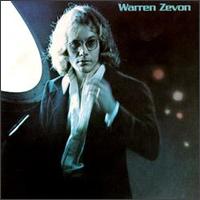
I've finally gotten ahold of Warren Zevon's first album, Wanted Dead or Alive (1969). It was a commercial and critical flop and he didn't release another album until 1976 (the fantastic Warren Zevon, featuring such tracks as 'Poor Poor Pitiful Me', 'French Inhaler' and 'Desperadoes Under the Eaves').

Wanted Dead or Alive certainly doesn't have any 'Desperadoes', but the first two tracks are pretty great. Definitely worthy of a place in the canon. Track 1, 'Wanted Dead or Alive' even features the trademark Zevon 'Ooough!' (or however you spell that grunt-yelp). Track 2, 'Hitchhikin' Woman' sounds a bit like latter day Dave Wyndorf, which is a good thing, I think.  Not sure about Zevon's cover of 'Iko Iko' at track 5.

Three sparrows
Oh (he says, trying to sound off hand), there's a new review of A Man Melting, this time in the fantastic, globally-focussed, globally-reaching The Short Review. Angela Readman's review is very kind. It includes phrases like, "The book encapsulates what the best short story should do," and "There are stories here I’ll simply never forget." Aw, shucks.

A fantail in flight
There's also an interview with me over at The Short Review.  A shout out to the fantastic Tania Hershman, the founder of TSR and a great short story writer in her own right. Look out for one of Tania's stories in the forthcoming Slightly Pecular Love Stories from Rosa Mira Books.  (I also have a very short story in the book called 'Statues'.)

Shag and oystercatcher at the end of Houghton Bay Road.
I got my tree-geek on in Australia, but unfortunately Aussie book publicists aren't that big on botanical knowledge. Outside the Riverside Theatre I spied what looked like four ti kouka/cabbage trees. I went to inspect and they looked just like the ones back home. When I asked my local 'guide' what they called these trees in Australia, he said they were pandanus palms. Really? I didn't know for sure at the time. There are a whole bunch of Australian plants I've only really heard mentioned in Tim Winton novels (karri trees, jarrah, spinifex). But I just looked up pandanus online and those trees definitely weren't that and definitely were Cordyline australis.

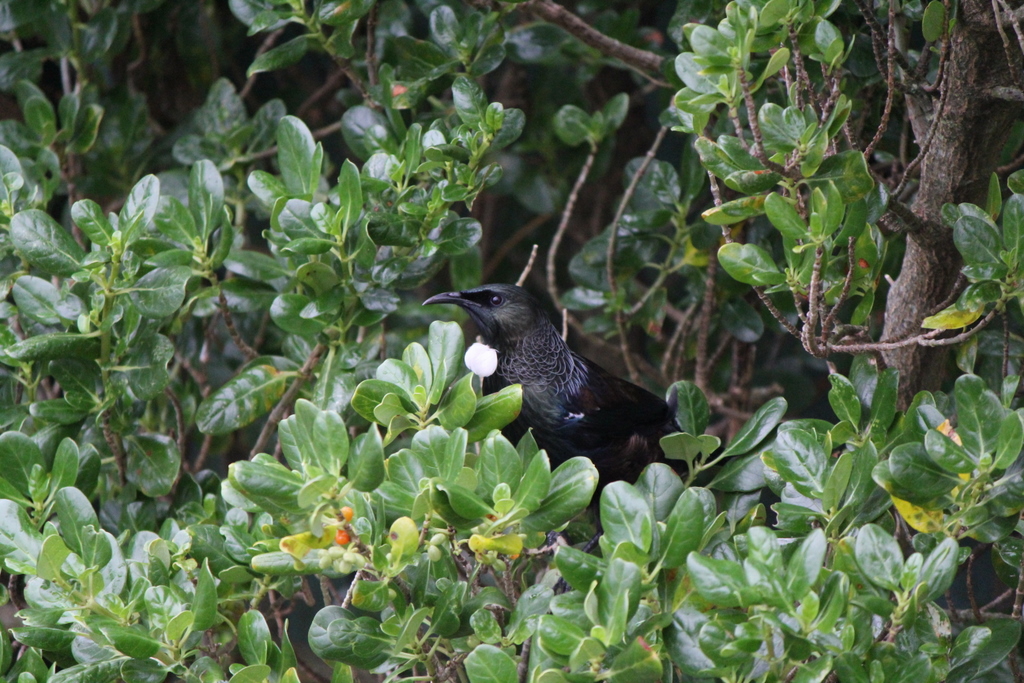
Tui in the taupata behind our clothesline
Okay, I've now finished listening to Wanted Dead or Alive and there were some more spacerock moments (track 9, 'Gorilla' for instance). Some weak songwriting (relatively speaking) and a bit over-produced country in some parts ('Tule's Blues' is whack compared to the demo on 'Preludes'), but definitely an album I'll listen to in certain moods.

Young gull and Bluebridge ferry
Actually, I'm listening to it a second time right now!

Sparrow eating toetoe
I've been meaning and meaning and meaning to do some kind of a catch-up reading post as I haven't done anything like that since January. 2011 where have you gone?  (Come back, you've been so good to me so far).

A couple of things I've read/listened to recently: Endurance by Ernest Shackleton (audiobook), Fahrenheit 451 by Malcolm Bradbury (audiobook), lots of poetry (Airini Beautrais, Saradha Koirala, Ian Wedde, 99 Ways Into NZ Poetry), The Long and The Short of It and Sport 39. It's about time to dive back into a big fat novel I think... though I should be diving into the writing of my own.

Silverye/tauhou
Speaking of readings, I've now read from 14 of the 18 stories in A Man Melting.  I'm committed to reading from 'Oh! So Careless' (and Owen Marshall's 'Don't Blame Yourself At All') when I talk to Massey first-year creative writing students in September, so that's 15/18. I'm also going to talk to the Short Fiction workshop up at Vic this coming Monday and will try and read to them from one of 'Seeds', 'Another Language' or 'Give Me Bread and Call Me Stupid'. I'm also guest speaker at Fiona Kidman's writing group and I'll be appearing at Melbourne (25-29 Aug) and Going West (10-11 Sept) writers festivals, so I'll more than certainly knock all eighteen off before summer.

Which poses the question: am I allowed to read from new stuff yet?  I'd quite like to read from '30 Ways of Looking at Marumaru South' and 'My Yale and My Harvard' when they are still relatively fresh in my memory...
Kingfisher on powerlines